±3 g on a Vertical Dough Divider: Three Links, and One Loose Link Is Enough to Drift
Don't blame the operator.
When the weight is off, the first guess is always the same: he pressed too hard, or he pressed too light.
Neither guess gets anywhere near the real cause.
Everyone prints the same line on the spec sheet: dough weight ±3 g.
Printing it costs nothing. Holding it costs money.
In this class of semi-automatic machine the industry standard is ≤5 g. We publish ±3 g.
Buyers see the two numbers and ask the same question: what do those 2 g have to do with me?
Everything to do with the person standing at your bench.
A 30 g bun that misses by 3 g is off by 10%. At twenty thousand pieces a day, that is a batch where every piece looks fine on its own and every piece is slightly wrong. Your cost is built on 30 g. Your bag is printed for 30 g. Your price is quoted at 30 g.
You eat those grams.
If you cannot hold 30 g on a single piece, why would a buyer trust you with the bread?
No slogans in this piece. Just where the 3 g comes from, and why it holds.
1. On a vertical divider, the weight is fixed at the disc
A vertical divider only makes three moves.
Dough goes onto the cutter disc. The head comes down and presses the dough into the holes. The knife cuts flush against the disc, and the pieces drop to the rounding plate to be rounded.
The weight is settled between the first move and the second.
Press dough into a hole, and that piece weighs whatever the hole holds at your dough's density.
Rounding changes shape, surface, roundness. It does not change weight.
The weight is fixed at the disc.
That sentence matters because it settles who owns the weight.
Ask a buyer where weight error comes from and most will answer: the rounding. It does not. Round a dough a thousand times and you will not round a single gram into existence. Run the rounding too long and a piece loses a gram or two to surface drying, but that is water leaving, not the divider mis-dividing.
One clarification, so the two do not get mixed. On this machine you set the rounding time yourself, accurate to 1 second. That second governs roundness, not weight.
So the three things below all happen at the disc.
Whether a vertical divider holds its weight comes down to those three being right at the same time.
Machine scope: this is the vertical dividing structure itself. The Smart Dough Divider & Rounder (Vertical) and the Semi-Automatic Dough Divider & Rounder (Vertical) share the same mechanical logic on all three; they differ in who performs the lifting, whether the timer sits on a screen, and how finely the knife frame is welded and fitted.
2. The weight has only three multipliers
Weight per piece is three numbers multiplied:
cavity volume × dough density × fill rate
In plain terms: how big the hole is, what a cubic centimetre of your dough weighs, and whether this press filled the hole.
Each multiplier has an owner.
Density is your recipe. Water, flour, fat, dough temperature, all of it. Leave the same batch on the bench until afternoon and the density has moved. That is physics; the machine cannot change it.
Volume is our tooling and our machining.
Fill rate is whether the hole filled, on this press.
It is tempting to treat the first two as given and the third as the machine's job.
The third is the result of the first two.
A hole that is off fills on one press and misses on the next. A knife frame that does not sit tight against the blind holes lets dough creep into the gap, and the hole comes up short. Fill rate is never dialled in on its own. It is what volume and the knife frame add up to.
Which is why most of the error a buyer feels sits in that third number.
Why?
Because the first two are static: machine them once and they hold. The third is recalculated on every press, and a machine with one loose link recalculates it differently every time.
Hold it and you get ±3 g. Miss it and you get 5 g, 8 g, whatever your luck gives you.
3. Link one: cavity volume comes from tooling, not from sorting parts
Thirty-six holes in a 36-piece disc.
The first fork in the road is whether you buy the disc or cut your own tooling.
With a bought disc there is one thing you can do: sort. Pick the discs from a batch that sit at the tight end of tolerance. Then what? What about the next batch? What if the supplier changes machine tools, or changes steel mill? Sorting hands your tolerance to somebody else's machine.
We took the other road. Core parts come off our own tooling, at our own tolerance.
Tooling costs money up front. You pay for a set before you build the first machine. That is why not many factories do it.
The payoff is one thing, and it is hard: hole-to-hole consistency is ours to set, and it is the same in every batch.
The disc then goes through precision grinding.
Grinding is not cosmetic. It sets surface finish and where the dimensions land. Half of the micron-level tolerance we publish is in the tooling; the other half is in this grind.
What happens when the bore is rough?
Dough pressed into it meets more friction. At the same pressure the hole does not fill. That piece runs light.
Worse is build-up. A rough surface holds leftover dough from the previous press, so the next press fills short. One hole, one light piece, then one heavy piece.
One more detail few people count as precision: chrome plating.
Cutter disc and rounding plate are fully chrome-plated on every dough-contact surface. How evenly the plating goes on changes volume directly. Plate thicker and the hole shrinks. Plate unevenly and one side of the disc is not the same as the other.
So fully chrome-plated is not only about washing up. It is part of the accuracy.
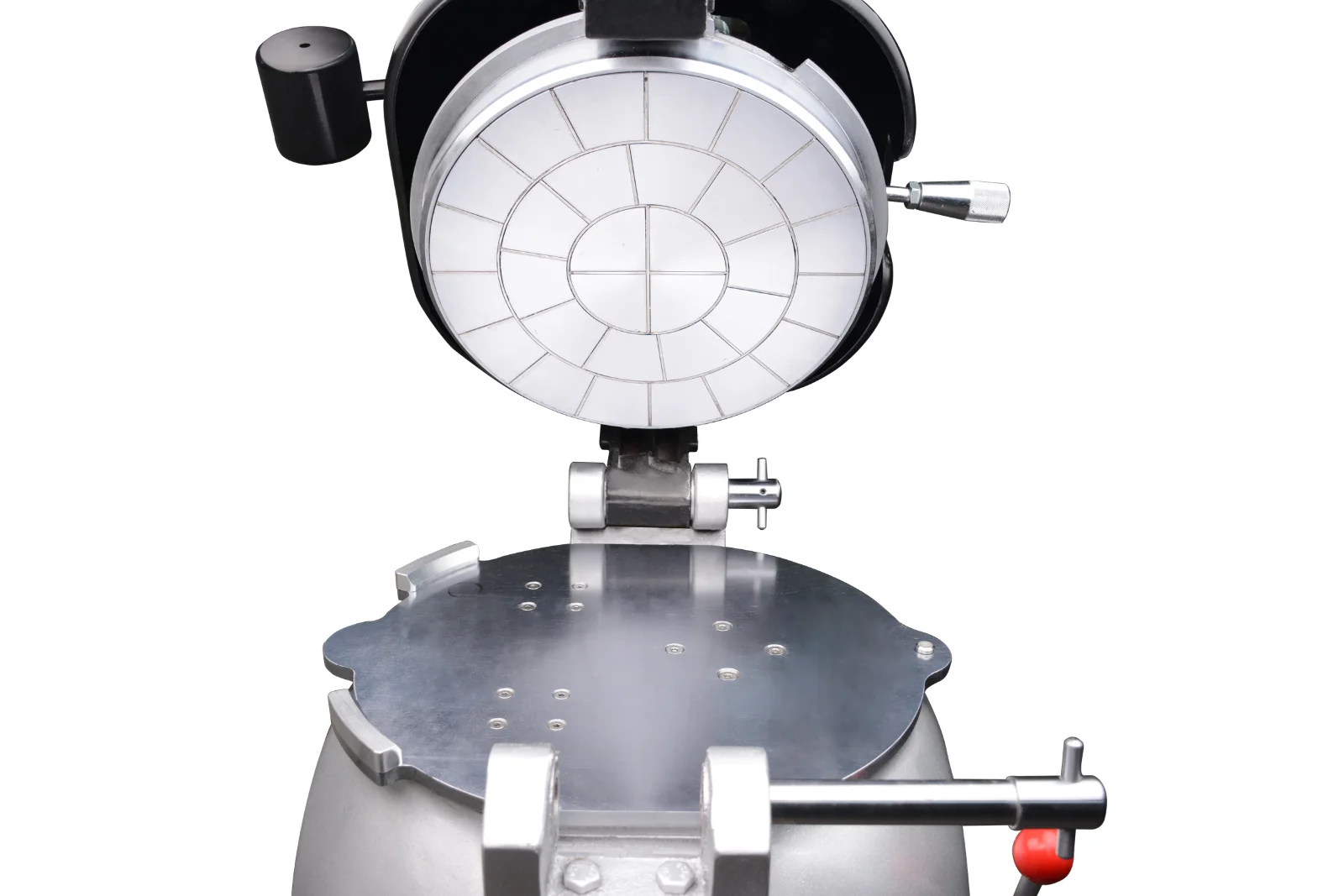
The hole is right and the bore is smooth. One part remains. Who cuts the hole?
That part is not on the hole. It sits behind it.
4. Link two: the knife frame, the layer most factories will not discuss
The last section was about the holes.
A hole that is right still needs dough pressed into it and cut clean. The cutting knife does that. The knife frame carries the knife.
That part matters more than the hole, and fewer people will talk about it.
The frame has to mate with the blind holes in the disc almost without clearance. The window is narrow.
Make the blade a little thick and it binds against the disc. Running bound, it wears fast. Where does the wear go? Into the dough. That stops being an accuracy problem and becomes a food-safety problem.
Make the blade a little thin and the gap between blade and blind hole opens up. An open gap holds dough. Leftover dough shifts the next press, and clearing it means stripping the head open every day. When a buyer complains that the machine has to be washed daily, this is where it starts.
Too thick fails. Too thin fails. The distance in between is the most expensive stretch on the whole disc.
What holds it?
Welding.
Our knife frames are welded by a man who has spent twenty years welding on vertical dough dividers.
To an outsider welding is joining two pieces of steel. Anyone who has done it knows welding is heat, and heat brings distortion. How much flatness the frame loses after welding decides whether the cutting knife can run flush against the disc face.
So this is not one number to settle. It is four:
- how much tolerance to leave between the parts;
- how much flatness to hold after the knife is welded;
- how much weld strength the seam needs to take the force of a dividing stroke;
- where the weld points go, in what order, and how the frame is trued afterwards.
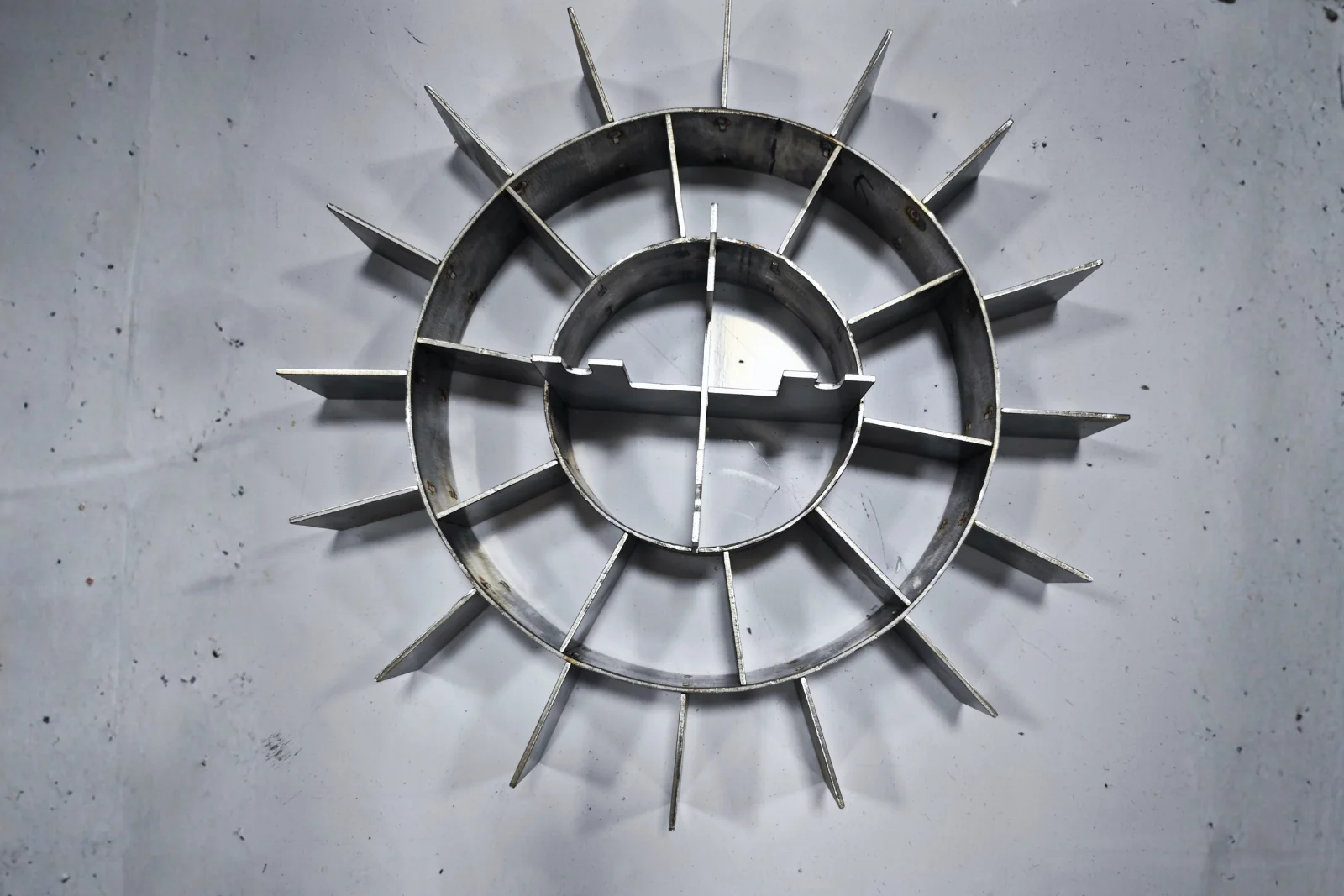
Those four numbers were built one version at a time. They are in no handbook.
No supplier sells them either. They come from machines that ran, dough that went through them, and feedback that came back from customers.
And no single number lasts forever. A 16-piece, a 26-piece, a 30-piece and a 36-piece disc each start the count again.
Which lets us say something others avoid saying. Building something that looks like this machine is not hard.
What is hard is the few numbers inside the disc and the frame.
The shape can be copied. These numbers have to be earned, year by year.
It is also why two machines can look alike and not run alike. Clean dividing, no jamming, no daily strip-down: all of it lives in those numbers.
5. Link three: three months in, three places wear
The first two links decide whether the machine is accurate the day it leaves.
The third decides whether it is accurate three months later.
This is where buyers actually get hurt.
On trial day every piece weighs right. Back in the workshop, three months in, the weight starts to drift. What you weigh in the morning is not what you weigh in the afternoon.
The cause is not on the drawing. It is in three places that wear.
The first is how the rotating parts are located.
The disc turns, and turning needs a location. The enemy is fatigue spalling in the bearing. Once spalling starts, position moves; when position moves, the distance between knife and blind hole moves with it.
We use bearings to Japanese standards, NSK and NHK. Not to put a name on the page, but to keep standing where it stood when it left, after tens of thousands of cycles.
The second is the edge of the cutting knife.
A dulled edge does not cut. It tears.
A tearing cut pulls a little dough away and leaves a little dough in the gap. The piece that lost dough runs light; the piece after it runs heavy. You will not see it the week you change knives. Run a month and the spread across a hundred pieces starts to open.
The third is the plating inside the bore.
Plating is the last correction made to volume, and it wears too. Wear it thin and the hole grows. Wear it rough and dough begins to build up.
This one is the quietest, because it moves across every hole at once instead of jumping from piece to piece. You cannot point at a bad piece. You only feel that this batch runs a little light.
Drift is not an accuracy problem. It is a wear problem.
Accuracy is geometry. Drift is time. Buyers judge accuracy when they buy and live with drift when they run. Quality staff know the difference best: is what you weigh the day the machine arrives the same as what you weigh after a service six months later?
So whether the number you weighed in year one still holds in year three depends on how fast those three places wear.
The most expensive thing in this trade is not a part. It is four words: still accurate in three years.
6. Beyond the three: two things carry the machine's name but sit in your hands
The first is your dough.
Same disc, same machine: dough at 60% water and dough at 70% water do not weigh the same. Dough temperature matters too. Cold dough is stiff dough, and stiff dough fills short.
That is not the machine's fault. It is the boundary of volumetric dividing itself: it divides by volume, not by weight. For volume to equal the weight you want, density has to stay inside a range.
The second is whether the disc matches the weight.
16-piece covers 100–200 g, 26-piece 50–140 g, 30-piece 30–100 g, 36-piece 10–70 g.
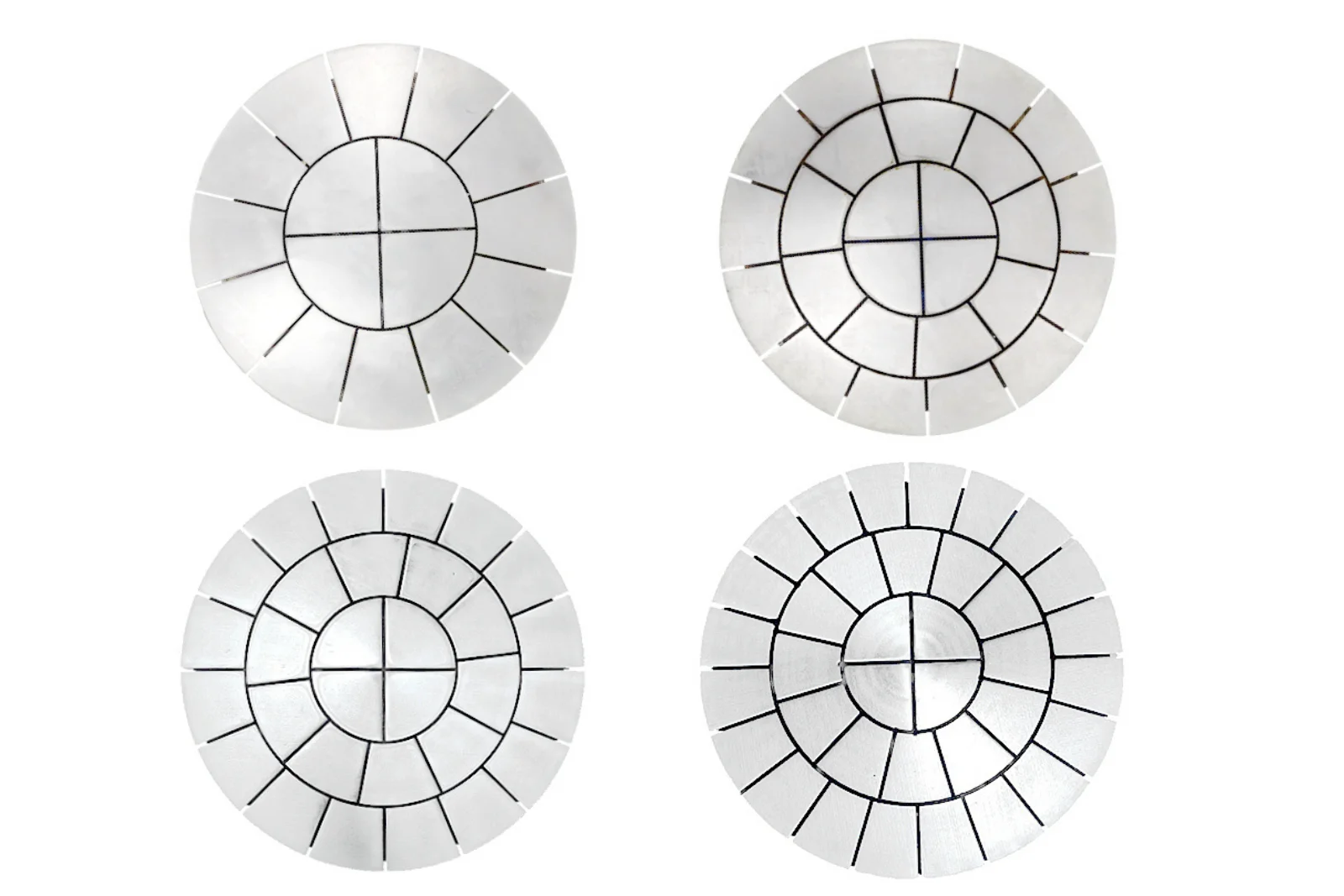
One disc covers one band. Running 30 g on a 16-piece disc is not an accuracy problem. It is the wrong tool.
One more line belongs here, not in a footnote. The 10 g band is reached by the Smart model, BK-Smart, and by no other model. Every other one starts at 20 g. A 36-piece disc does not change that.
Not because the disc is lacking. It is that the smaller the piece, the bigger the share any given error takes. One extra gram on a 20 g piece is 5%. On a 200 g piece it is 0.5%.
Shrink the denominator and every hidden fault in the machine shows up.
7. The three links, together
| Link | What it decides | What happens when it slips |
|---|---|---|
| One · cavity volume | How big the hole is, how heavy the piece | Hole to hole varies, piece to piece varies |
| Two · knife frame and blind hole fit | Whether the cut is clean, whether it jams | Blade too thick binds and wears; too thin leaves dough in the gap |
| Three · wear (locating, edge, plating) | Whether it is still in place three years out | Runs looser and looser, morning and afternoon differ |
The table makes one point: these are not three selling points. They are a chain.
Take out any row and the ±3 g is no longer that number.
All three at once puts that line on the spec sheet. Miss one and you buy ±3 g on paper and a different number on your floor.
8. What ±3 g does not promise
We write this section in every article.
±3 g is our published figure, not a guarantee on every piece.
Why 3 g each way? Because error runs both ways.
Underfilled, the piece runs light. Leftover dough carried into the next press makes it heavy. Both directions stay inside 3 g, so we publish ±3 g.
You should still know the conditions:
- The figure is quoted against the weight band of the matching disc. A 36-piece disc covers 10–70 g; it is not a 16-piece disc asked to run 10 g.
- The figure moves with your dough. Water, dough temperature, proofing: any of them will move it.
- The figure is dividing error. It does not include the little water a piece loses from its surface after rounding.
- A new machine and a three-year-old machine are not in the same state. The third thing in section five exists to keep those two states close.
We will not claim this machine never needs adjusting.
We will claim this: it does not ask you to adjust it because something wore loose.
Last
Weighing has never been a performance for us.
It is the one thing you can check on the spot.
Bring a batch of your own dough and the disc you mean to run. We run a continuous stretch, sample at random, weigh piece by piece.
How long we run, how many pieces we take, how we weigh them: you decide.
If the numbers fail, we accept it.
If you are running the same arithmetic on your side, how many pieces a day come out wrong and how long the person topping up the weight stands there, send me your recipe dough. I will run it first and send you the video of the re-weigh.
Message Robert on WhatsApp and tell me your weight and your disc size.