Run a Divider Three Years. How Much Weight Do You Lose? The Number Was Fixed Before It Shipped.
Accuracy ages.
Faster than the machine does.
That is not my line.
In 2017, a leading European bakery-equipment maker under the Hillenbrand group put this in a public technical article of its own:
Most high-capacity dividers hold a standard deviation of 2.5–3.5 g while they are new, measured on 800 g loaves.
The hard part comes later. As a divider ages, that deviation degrades, and it often degrades quickly, into the 5.5–7.5 g range.
The same article gave buyers a piece of advice: when you select a machine, weigh the initial deviation and the expected deviation both, and ask every potential supplier for that number.
One of the best divider builders in the world wrote that. On its own website.
It was writing about the industry. It was also writing about itself.
So this piece will skip the sentiment. It is about one thing: why a number ages along with the machine, and why that number was already settled the day you signed.
Start with the arithmetic
How does weight variation turn into money?
Three steps. Crude, but they hold.
One: every piece has a floor. Below it, the declared net weight fails.
Two: so you cannot set the target at the midpoint. You push it up, until even the lightest piece clears the floor.
Three: the wider the spread, the higher you must push. Every gram you push is money with no return.
A public estimate gives you the order of magnitude: a toast line running 8000 pieces an hour, 140 hours a week, costs an extra 2240 kg a week — over 2 tonnes — for every 2 g you add to the average.
More than 100 tonnes a year.
Those figures are not ours. They are published, and you can look them up and plug in your own.
We will not hand you a final number, because dough cost, product mix and running intensity differ from plant to plant. But you can do the sum yourself: pieces per hour × hours a day × days a year × the grams you add to cover the spread ÷ 1000 × your dough cost.
What comes out is what leaves your workshop every year without a sound.
And it has an ugly property. It is not a one-off. It climbs, year after year.
Because the gap inside the machine widens, year after year.
Weight is pulled in, not dialled in
To explain why accuracy ages, I have to explain how it was accurate on day one.
First, the scope, so nothing gets muddled.
A Tapered Divider & Rounder is two machines: a divider (BAFP or BAFC series) and a tapered rounder (BAG series).
This article covers the first one only. How the rounder makes a ball is a different article.
A divider does not weigh dough. It fills with it.
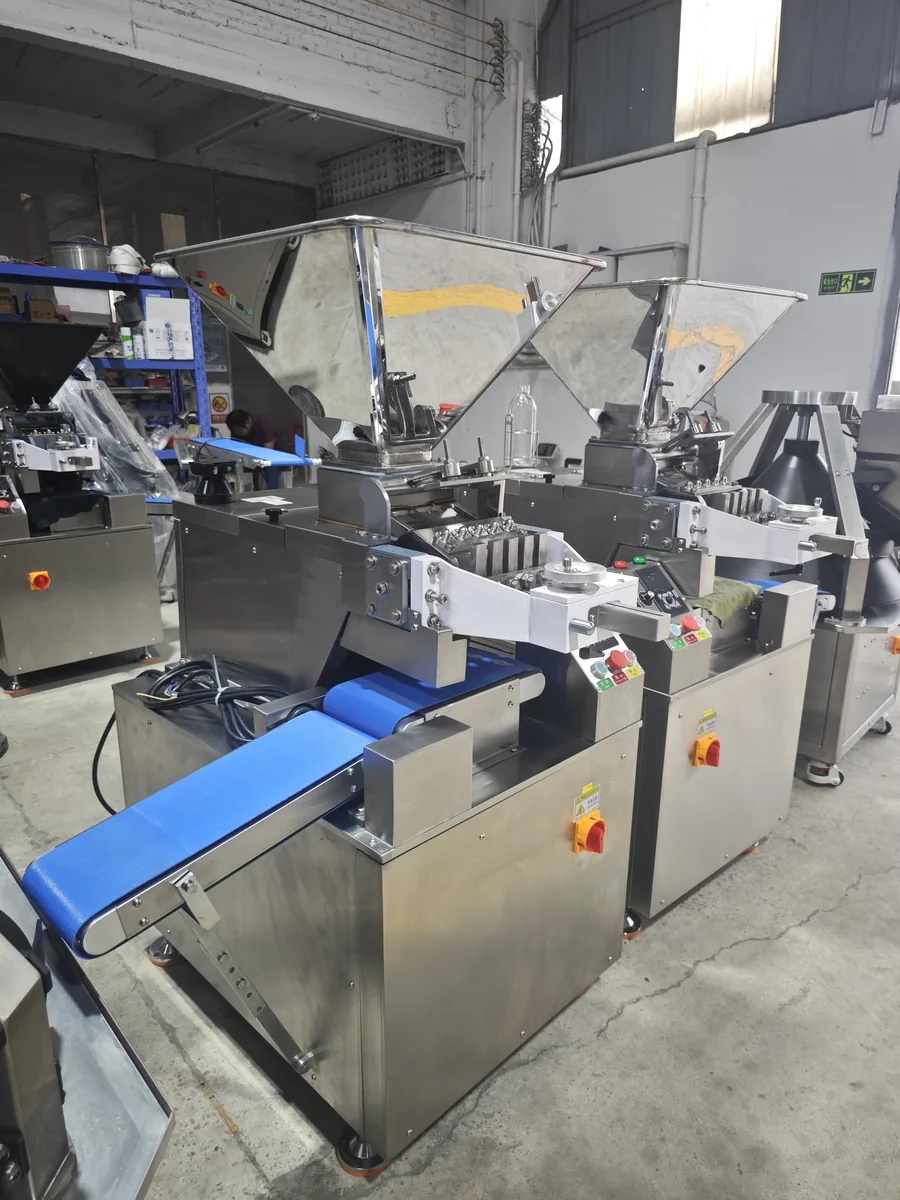
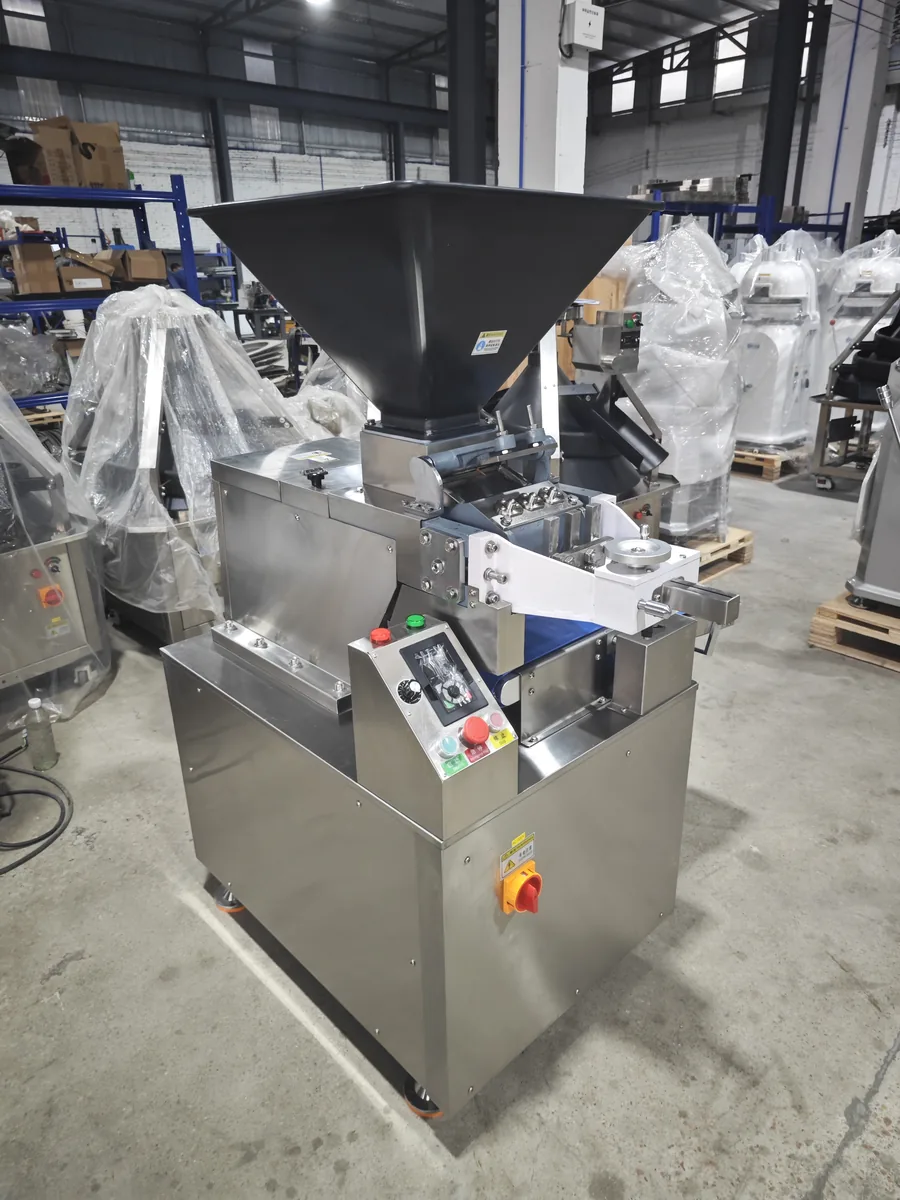
The piston draws back, vacuum forms inside the chamber, dough is pulled into the metering chamber, and the knife cuts at the moment of suction.
The weight of one piece is the volume that chamber swallowed in one stroke.
So the chain runs one way, four links, each holding the next: vacuum suction → air-tightness → three sealing faces → machining tolerance.
It does not run backwards.
The control panel does not produce weight. It only sets a target.
That sentence matters, because it tells you where to look when weight falls short. Most people reach for parameters, a new controller, a different electrical scheme. Wrong direction. When weight will not come up, check the tolerance and the three sealing faces first, air-tightness second, and the electrics last.
Which three faces?
The base, the bottom seal. The pusher, where the piston pair mates. The front, where the panel joins.
Air-tightness is never one face. It is all three holding at once. Leak at any one and vacuum falls short; vacuum short and the chamber under-fills; under-filled and the weight ceiling drops.
That is why "rated 110 g, delivers 95 g" is not rare in this industry. The rating is written at full volume. Delivery is limited by the air-tightness you actually have. The difference between the two is the difference in sealing.
One boundary has to be drawn here, because it gets muddled constantly.
A machining tolerance of 0.04 mm is a geometric figure on the sealing faces. It is the evidence behind sealing capability. Piece-weight accuracy is something else: the spread of what you actually deliver, and it is stated as a distribution.
Calling 0.04 mm "weight accuracy of 0.04 mm" mixes two different things.
We do not talk that way. Weight gets settled on a scale.
Ageing takes only three routes
Back to ageing.
The word is too vague to carry information. Take it apart and three physical routes remain.
Route one: the sealing faces were never good enough.
The weight ceiling was out of reach on day one. That machine was low from the start. It did not get worse; it was never right. This is not ageing. It is a job not done.
Route two: the mating pair wears.
This is the main road. The piston cycles tens of thousands of times a day, tens of millions a year. Two faces run against each other, and the clearance between them only grows. Clearance grows → vacuum leaks there → the chamber under-fills → weight drifts down year by year.
Route three: material density breaks down.
Corrosion and porosity. Under vacuum both turn into leak paths, and they bring a nastier consequence along with them: food contamination.
All three end up in the same place. That gap.
So the real question is not whether the parts were made accurately. It is two questions:
Once assembled, is the gap even? After hundreds of thousands of strokes, is it still where it was?
One is about space. One is about time.
Three processes, not three add-ons
On the piston pair, more than one thing needs handling.
Three are covered here. The rest is our own process, and we do not hand it out.
| Process | What it stops |
|---|---|
| Natural ageing of the casting | Slow movement after machining → accuracy leaves on its own within weeks |
| Curved-surface and flow-channel finishing | Dead corners the tool cannot reach → dough build-up, inconsistent fill |
| Surface hardening | Clearance growing with wear → vacuum leak → weight drifting year by year |
Three processes, three failure modes, one to one.
The next three sections take them one at a time. Each says only three things: what it stops, why it is hard, and what happens without it.
Not how it is done, and no parameters. Parameters are part of what we are; you could not verify them anyway. What you can verify is the result, and that comes at the end.
Process one · Natural ageing: let it finish moving first
Of the three, this is the least like technology and the most like waiting.
A casting comes off the floor and does not go to the machine. It sits.
Sitting there doing what? Finishing its own movement.
From the moment iron solidifies, tension lives inside it. Wall thickness varies, cooling rates differ, and elastic strain sits between the grains with nowhere to go. Cut the skin off on a machine and that balance breaks on the spot, and the part starts to move.
A face ground flat yesterday becomes a microscopic banana in a few days.
You cannot measure it. It is slow, it is global, and it is uneven.
So what ageing buys is not accuracy. It buys how long the accuracy stays.
That time cost is one a lot of factories will not pay. Sitting means money tied up: capital parked, floor space parked, the schedule blocked. A shop that has to turn inventory hates the word wait.
The shape is part of this process too.
The chamber, the flow channels, the transition fillets, the ribs: those are formed at casting, not carved out of a solid block by a machining centre.
Why can you not carve them? Two reasons.
First, grain flow gets cut. Casting solidifies along the contour, so the fibre is continuous. Mill it out and you cut the fibre, drop the strength, and open up internal shrinkage cavities and porosity.
Second, stress. Take a block and remove eighty percent of it, leaving a thin-wall chamber, and that cut destroys the stress balance on the spot. The part warps while it is still on the machine. The tolerance is gone before the fixture comes off.
Cast it, let it sit, then machine it. There is no shortcut here. Only time and money.
Process two · Curved surfaces and flow channels: erode what the tool cannot reach
Sinker EDM erodes metal with pulsed electrical discharge. The electrode never touches the work, and no cutter is involved.
Why is it necessary?
Because some places a cutter cannot enter.
A ball-nose cutter has a radius. At a sharp internal corner, a deep cavity floor or a three-dimensional blended surface, the tool has to swing wide, and what comes out is a radius, not the shape you wanted.
EDM does not have that problem. It follows the electrode. Whatever shape the electrode is, that is the shape of the cavity.
There is a second point, and it matters more: no cutting force.
A cutter pushes thin walls and complex curves out of shape. One push and the dimension is gone. EDM does not touch, so there is no mechanical stress. What gets eroded is exactly what you see.
What does that do on a divider?
It handles the transitions. How air moves, where dough fills, where it piles up.
Get those right and every evacuation meets the same resistance, and every fill lands at the same density.
Get them rough and dough collects in the dead corners. It sits there, ferments, sours, and sticks to the wall. The next fill finds that space already taken, and comes up short.
Same chamber, one light piece, one heavy piece.
When a customer says the batch is all over the place, it is usually not the settings. There is a lump of yesterday's dough in a corner.
Why does the cost of this process climb so steeply?
Because the electrode erodes too. Copper is soft, large electrodes warp easily, and one electrode loses a little on every run — complicated shapes need several. Machining runs long, flushing is hard, you cut the parameters and lift the electrode again and again, and the machine stays occupied. Then comes post-processing: discharge leaves a matte skin, and where it has to seal, someone polishes it by hand.
So which faces get EDM, how it is sequenced against the CNC work, how far it gets polished — that combination belongs to each shop.
EDM is not there to make the machine look better. It is there so nothing inside holds dough.
Process three · Surface hardening: both faces, not one
When customers hear chrome, they think easy to clean and shiny.
True. That accounts for a third of it.
The first job of surface hardening on a divider is wear resistance.
The piston pair reciprocates at high frequency, two metal faces running against each other. Raise the hardness and wear slows; wear slows and the clearance opens more slowly; the clearance opens more slowly and weight drifts more slowly.
The second job is galling. Two faces pressed hard enough under pressure bond locally. Move them and they tear. What tears off is metal.
Where does the metal go? Into the dough.
At that point it is no longer an accuracy problem. It is a food-safety problem.
The third job is adhesion. Dough carries water and mild acid. Plain carbon steel and stainless both micro-corrode against it and hold onto it. Chrome is chemically stable: it does not rust, it does not hold dough, and it washes clean.
The fourth job is holding the seal. Hardening is followed by grinding and polishing. The flatter the surface, the better it holds the seal, and the better the vacuum is retained.
Of those four jobs, only the fourth changes volume directly. The first three change how long the volume holds.
One detail gets missed easily: the piston body and the cylinder both need it.
They are a mating pair in relative motion. Harden one side and the soft side wears first. Wear the soft side and the effort is wasted.
While we are here: why do some machines look hardened and still do not last?
Uniformity.
A slightly thicker layer shrinks the chamber slightly. An uneven layer means one end of the machine differs from the other. Worse, unevenness causes local binding: tight here, loose there, and it runs into uneven wear.
So this is not a matter of buying a machine. It is the whole surface-treatment supply chain.
Let one link drop and every precision fit ahead of it is wasted.
They have an order.
If ageing was not done properly, the part is still moving. Grind the shape perfect and in a few weeks it has moved again, and the work is wasted.
If finishing was not done properly, dead corners keep dough and the chamber never fills. Hardening the clearance to perfection will not help — an under-filled chamber is a filling problem, not a clearance problem. Two different things.
The order is: let it settle, get the shape right, then let the surface hold time.
Reverse it and you spend the same money for nothing.
What it does not promise
Every one of these pieces carries this section. This one needs it more.
One: it does not promise zero decay.
Wear is physics. Hardening slows the rate; it does not cancel wear. Three years in will not read the same as day one. What we do is make that difference land inside a range that does not disturb your production. "No difference at all" is not on offer. Anyone who promises it is lying to you.
Two: it does not promise every dough.
Vacuum suction divides by volume, not by weight. With high water content the dough is thin and the density is low, so the same chamber holds less weight. With cold dough it is stiff and does not fill.
On BAG series tapered rounders, 60%–75% moisture tested best. On BAFP series dividers the moisture scope is 55%–78%. Those are not the same scope, so do not quote one against the other.
And different flours absorb differently. Your dough decides.
Three: it does not promise every weight.
A tapered rounder on its own covers 10–300 g. For the divider, the 3P single-piece design ceiling is 110 g on the standard BAFP-3P and 100 g on the computerised BAFC-3P.
The figure "30–600 g" describes the whole line, covered in segments by 12–13 sets of tooling on sale. It is not one machine. Above 250 g is custom tooling.
Please do not accept "600 g on one machine". Put four things in writing at acceptance: which machine, which tooling set, which dough, what target weight. All four, or it is not a testable condition.
Four: it does not promise to replace a number of operators.
Labour cost, shift patterns and product mix differ far too much between markets. We do not write that line.
Five, and this is the important one: our field data on machines already in service is not yet a complete, citable sample.
That is the truth.
The only hard evidence for "still accurate after three years" is the same machine measured at installation, at one year, and at three years. We are building that data. This version cannot show it to you.
So until you hold it, make it a requirement of every supplier you talk to.
Us included. Including the makers whose findings this article quotes.
Four things you can check yourself
Process is talk. Distribution comes off a scale.
First: 100 consecutive pieces.
Not one piece held up for you. Run the machine until it is stable, take 100 consecutive pieces, and weigh and record every one — not 10 picked at random.
Then three numbers: the mean, whether it sits on target; the range, heaviest minus lightest; the standard deviation, how wide the spread is.
Then the step that actually matters. Sort the 100 and count how many land under your floor.
That column says more than any average.
For context, the more common sampling in this industry is a group of 8 to 12 pieces judged on deviation. We moved the bar to 100. Eight pieces cannot show you the tail of a distribution. A hundred can.
Second: a trial on your own dough.
Send a sample, or come in person, and run a batch with your dough.
The machine adapts to your dough. Your dough does not adapt to the machine. That is not a slogan. It is settled on the trial bench.
Third: strip it and look at the mating faces.
Take the piston pair apart and put your hand on the two faces.
Finish does not lie. Galling, dough residue, one side polished brighter than the other: you see it at a glance.
Fourth: ask a question most suppliers will not answer.
Not "is it good". Something specific. How much has the weight moved since the year this machine arrived? Do you have the re-check data on that older unit?
Take those four questions to anybody.
We have an answer to each. Except the field data. We do not have that yet. We are building it.
Last
The spec sheet says 0.04 mm or 0.08 mm, and customers can read that.
What the spec sheet does not say is how that gap behaves over time, and how many extra passes the people who build the machine walked in the workshop to make it behave more slowly.
A shape takes three days to copy. These three processes take years to accumulate.
We will not tell you this machine never needs attention.
We will tell you this: it is not asking you to re-tune the weight because something quietly wore loose.
If you are running that arithmetic on your side — weight heading down, batch-to-batch swings, a chamber that never comes clean — send me your dough and the numbers you are getting now. We will run a batch to your recipe and send you the distribution across 100 consecutive pieces.